How do delays and reinspections affect delivery dates?

by Renaud Anjoran on February 9, 2010

I got an interesting email this morning from a reader from India, working on some kind of thesis for her professional training program:

I want to know more about how delays and re-inspection affects delivery dates and how can it be controlled?

This is a straightforward question, and I think it might also be of interest to some other readers. So here is my response, in substance.

Delays in production, as well as inspection failures that involve re-work & re-inspections, delay the shipment date (ETD). And if the transport arrangement is unchanged, it translates into a delay in arrival date (ETA).

There are several types of solutions:

-1- The supplier accepts to send a part of the goods by air (maybe 20% of the order quantity) and the rest by sea, to make sure the importer does not miss sales.

-2- The supplier sorts out the acceptable products, gets them validated by a QC inspection that only targets these products, and ships them first. Then the rest of the goods can be re-worked and/or re-produced properly, with less timing pressure. If necessary, an inspection company can do the 100% check of these remaining products.

-3- The buyer thinks about this risk in advance and takes actions to prevent it: inspections of the first finished products and/or inspections of the first 20-30% of finished products. This is the best way to catch issues early and make sure that (1) the factory is aware of problems to avoid for the rest of production, and (2) the already-finished goods can be re-worked and/or re-produced without involving much delays–hopefully.

You will notice that all these solutions cost extra money to the factory AND to the importer. Receiving the same order in two shipments rather than one (under FOB terms) costs higher in-country forwarder fees.

QC inspections are often seen as “luxury” expenses, but in this case it is clear they have the power to reduce the total landed cost (if they are used as a prevention tool–see option 3 above).

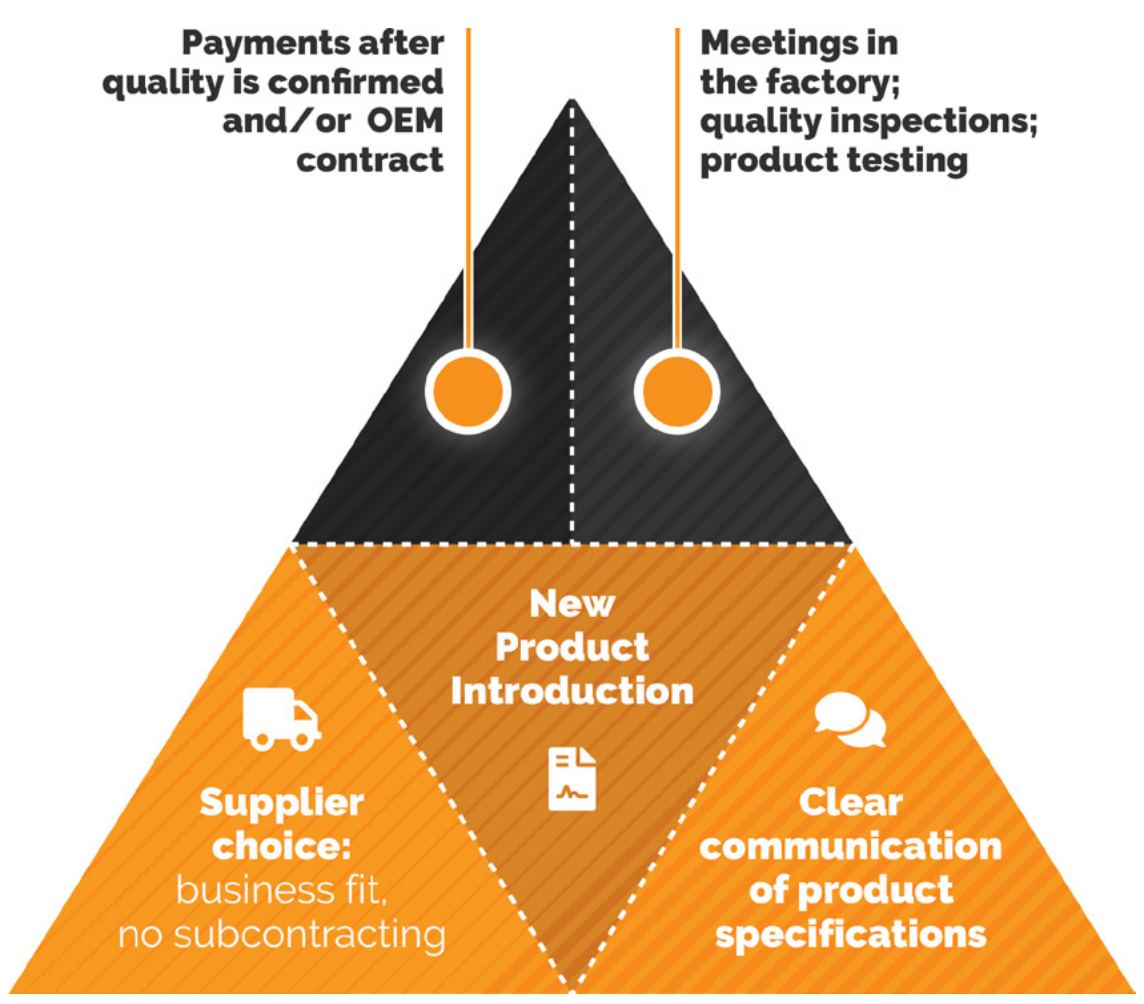
I would add a fourth solution: select the factory carefully and make sure they understand the buyer’s requirements (both in terms of quality and timing).

Any other tips?

———————–

Related post for further reading: Managing urgent shipments in China

  • Share/Bookmark

{ 0 comments }

Partnering with a Chinese factory: a sweet dream?

by Renaud Anjoran on February 6, 2010

Most new buyers coming to China want just one thing: to find one or two good manufacturers that they count on. They think “if I were a manufacturer, I would try to find a few stable customers and make their lives easy, and everybody would win”. Unfortunately, they do not understand their suppliers’ point of view.

First: why the need for a manufacturing partner?

The first contact with a new supplier often gives buyers a good feeling. They place orders, and then the problems begin: misunderstandings and poor quality, delays, price increases, and all sorts of cat-and-mouse games. (Note: I am referring to the majority of cases, not the few situations where all is fine).

Managing relationships with Chinese suppliers can be a delicate balancing act:

  • When a buyer is seen as too tough, factories don’t want his orders any more, and make it clear by increasing prices and/or by providing a poor follow up.
  • When a buyer makes efforts to accommodate production constraints, the supplier understands it as a weakness and thinks “they are making concessions, so they really need these products and we don’t need to make extra efforts”.

Importers try to find a solution. Many end up proposing a deal that comes like this:

We propose to develop a partnership with you. We like you and we are sure you can satisfy our needs over the long run, so we will keep buying from you. Are you interested?

[Subtitles: (1) we hope you'll see us as a valuable customer and you will treat us accordingly; (2) if we get better pricing and reliability, we'll win market share and you will end up benefiting from it]

To this, the supplier responds:

Sure, that’s a good idea. Let’s be more like partners. Thanks.

What does a Chinese supplier understand by “partnership”?

Are they happy to see a foreign buyer committing to buying regularly from them? Sure.

Do they believe it? Probably not. Many buyers promise huge volumes–in the future–but fail to deliver. Why? Simply because they exaggerate to get a better deal, or because they switch to other (cheaper) suppliers.

So, are Chinese factories likely to provide anything of value in return? Not likely. Buyers have to walk their talk for some time before anything really changes.

Buyers from the US or Europe often talk about “win-win” and “long-term relationships”. What Chinese suppliers think is: “if I give you low prices and priority in production this season, I lose and you win; that’s all I can see”. It all comes back to their short-term view of business.

A couple of real examples

First example: a lack of credibility on the part of the buyer.

A French importer with whom I worked closely had been buying from China for about ten years. He had developed a purchasing system that allowed him to be really tough on his suppliers: it was okay for him to cancel a few shipments every season, because he could switch his customers’ orders to very similar items in stock.

This importer was always negotiating prices, trying to guess what the real costs were and how to drive the supplier’s margin down to the minimum level. He was spreading his orders among about 15 suppliers, to avoid relying too much on any one of them. Then, two years ago, he decided to be a “partner” with a few stable suppliers. The deal was: “we need lower prices, is it possible if we give you more orders?

The suppliers thought “oh, here you come with yet another tactic to kill my profit”. It was totally ineffective.

Second example: a lack of commitment from the factory.

A new importer who is launching his brand starts production in China. He finds a Chinese factory manager who has lived abroad for some time, and feels that he can trust him. He makes it clear that he keeps placing all his orders with this one factory. He even asks them to provide materials (against payment) to help his designer, and help him make lots of samples.

But, to the factory, this was a pretty small customer. After the first two orders, and as the QC pressure was reduced, the factory did not reserve any production capacity for this importer. They looked for a factory and outsourced all the products there, without adequate QC supervision. The result was disastrous.

And what about the following order, also given to this factory? The buyer requested in-house production. Prices for the new styles were 30% above what other suppliers quoted. After tough negotiation, prices went down a bit and the order was issued. Production is not subcontracted, but the buyer is not given any red carpet treatment. My conclusion: trust should come little by little, in the light of past achievements. Not before the first order!

So, how to push a supplier to be more reliable over the long run?

Proposing a partnership is essentially useless. But a number of appropriate behaviors can be followed. Here are a few ideas:

  • Accompany the factory at the beginning of the relationship, to explain them clearly what is acceptable.
  • Keep monitoring production quality, make sure to get written and signed records, and do not lower your standards for any reason (if possible).
  • Dump regularly the worst factories: those that can’t (or won’t) be reliable enough, and those that are growing too fast.
  • Give regular business to the best factories and walk your talk, as mentioned above. Make sure you are not seen as a bad customer.
  • Tolerate that the best factories get a reasonable premium on their prices: you will make it back easily on lower costs (better quality, less delays, faster responses, etc. all reduce your costs and help you please your customers).
  • Don’t switch suppliers for a few pennies, but keep them in competition with at least another factory to avoid unreasonable quotations.
  • Share/Bookmark

{ 1 comment }

When Japan envied China

by Renaud Anjoran on February 2, 2010

Everybody seems to have an opinion. I am of those who thing China will find its own path, as it has done until now, rather than following a specific model. Japan’s example is interesting, but the comparison has its limits.

Last week I read Toyota Production System by Taiichi Ohno, who literally gave birth to what we call lean manufacturing. In this book he tries to put his work into perspective, and it gives us some interesting insights:

Starting from low quality

First, everybody knows that “Made in Japan” meant low quality in the 1950s.

Just like China nowadays. No surprise here.

A mass production system as long as growth remains rapid

Second, Chinese factories like to process large batches and pay relatively little attention to quality, while the Japanese have long recognized the value of JIT and kanban systems, right? Wrong! Here is what Ohno writes (P1):

Prior to the oil crisis, when I talked to people about Toyota’s manufacturing technology and production system, I found little interest. When rapid growth stopped, however, it became very obvious that a business could not be profitable using the conventional American mass production system that had worked so well for so long.

Does it suggest that it would take a real, prolonged crisis for Chinese producers to look for models and adapt their operations?

Start from copying what exists, and then innovate

Third, the Chinese are generally seen as copiers rather than inventors, right? What about Japan? Here is what Toyota’s founder wrote around 1923 (P79):

Presently, white people question what contributions Japanese people have made to modern civilization. The Chinese invented the magnetic compass. But what invention did the Japanese make? Japanese people are merely imitators. This is what they say.

All of the above suggests that China’s manufacturing is not much different from that of Japan 40 years ago. I think what has allowed Japan to reach its current leading status in the manufacturing world was its willingness to go against common sense, and to adopt best practices from companies like Toyota. What about China? To be honest, I am not very optimistic.

PS: Toyota is currently having quite a hard time, with massive recalls. Guess where the defective accelerator parts were made? Probably in China.

  • Share/Bookmark

{ 0 comments }

Why is Wal-Mart developing business with Li & Fung?

by Renaud Anjoran on January 29, 2010

Two weeks ago Wal-Mart announced a push to more direct sourcing. And I wondered if the trend was still toward direct sourcing (and the elimination of sourcing/trading agents).

Then yesterday Li & Fung, the largest sourcing company (who owns zero factory),  announced a new deal to supply Wal-Mart:

The arrangement, signed yesterday, may generate an additional $2 billion of sales in the first year, helping Li & Fung meet its $20 billion revenue target for 2010.

Walmart will have the option to acquire WSG Pte, the buying agency involved in the arrangement, after Jan. 1, 2016, from Li & Fung, the outsourcer said in a statement yesterday, without setting a price for the unit.

WSG, the unit supplying Walmart under the new arrangement, will be based in Hong Kong and “over time will employ hundreds” of employees, Rockowitz said. Li & Fung started supplying the U.S. retailer in about 2003, he said, declining to place a dollar value on the amount of goods on how much his company currently earns from clients.

The margins for WSG will be “in line with those of a very high volume business,” Rockowitz said, without providing more details.

“[Li & Fung has] reached a level of scale in the universe of the sourcing world that it’s become the automatic go-to for retailers,” Matthew Marsden, who heads consumer research at Samsung Securities Co., said in a phone interview late yesterday.

Most articles talk about the deal’s impact on Li & Fung’s stock price. But what about Wal-Mart? What’s in it for them?

Fortunately, another article gives us an element of response:

The deal is expected to help Wal-Mart by reducing the number of importers it deals with, enabling the retailer to squeeze cost savings across its supply chain.

“We are redefining how we source products that are imported into Wal-Mart retail markets around the globe,” the Wall Street Journal cited Wal-Mart vice chairman Eduardo Castro-Wright as saying Thursday.

So it seems Wal-Mart will mostly substitute this new sourcing division to the job of “small” importers.

Are you an intermediary currently selling private-label goods from Asia to Wal-Mart? You’d better have a few other solid customers…

  • Share/Bookmark

{ 2 comments }

Getting to the root of a quality problem

by Renaud Anjoran on January 28, 2010

I was shocked many times by the unwillingness of supervisors, in Chinese factories, to find the real cause of a problem.

Here are just a few real-life quotes:

Workmanship is not good? The operator did not pay enough attention, so she will have to repair it. Next time she should be fired.

The products are not conform to the blueprints you gave us? But, you know, the customer’s designers don’t really know how production works.

We will miss the deadline for shipping? Our factory has bad feng shui!

According to Taiichi Ohno, asking why repeatedly is “the scientific basis of the Toyota system”. It has lead Toyota to make all sorts of improvements. How? By addressing systematically the root causes of obstacles to lower costs.

Ohno gives a great example of the “five whys”: let’s say a machine has stopped functioning:

  1. Why did the machine stop?    -There was an overload and the fuse blew.
  2. Why was there an overload?    -The bearing was not sufficiently lubricated.
  3. Why was it not lubricated sufficiently?    -The lubrication pump was not pumping sufficiently.
  4. Why was it not pumping sufficiently?    -The shaft of the pump was worn and rattling.
  5. Why was the shaft worn out?    -There was no strainer attached and metal scrap got in

I wish more Chinese managers (and if possible line workers) were trained to think this way… It would be a gigantic step in the right direction!

  • Share/Bookmark

{ 2 comments }

Re-inspections: the key is to manage corrective actions

by Renaud Anjoran on January 26, 2010

This post is about re-inspections following a rejection for quality issues. Not about second inspections that are booked because the first inspection was impossible to carry out (e.g. because a last-minute problem delayed all production, and nothing could be checked).

Sometimes re-inspections show the same results as first inspections, suggesting that no corrections were performed. Why? It can come from both sides:

  • I saw factories lying to a trading company, doing no real repairing, and just waiting until the importer has no more time and has to ship out.
  • But I also saw cases where the information from the purchaser is not clear enough, and no one in the supply chain knows what to do.

How to avoid such situations? I usually advise my clients to follow a few steps:

Sending guidelines to the supplier

Some importers ask for a re-inspection but do not wonder what it implies in the factory. When a shipment is rejected, they simply tell their supplier to “repair the products and set a re-inspection date”. But this is not enough. If you are a buyer in this situation, what should you do?

First, ask yourself “can they really repair these issues?” If so, ask them to do it. If not, there are basically three options:

  • Let the supplier ship the goods as they are,
  • Ask the supplier to sort out the bad goods and either re-produce (if there is no minimum order quantity problem on the materials and if timing allows) or short-ship,
  • Ask the supplier to sort out the worst goods (according to an exceptional tolerance) and either re-produce or short-ship. (Note that this “exceptional” tolerance might well become the standard for future productions, in the factory’s mind).

Second, list the steps that should be followed by the manufacturer. Below is an example, based on an email I sent to a supplier recently:

The shipment is refused, because of [XYZ problem reported by the inspector]. Please confirm your understanding.

Please tell the factory to follow this procedure:

  • Open all the cartons,
  • Check 100% of the pieces, sort out the pieces that are out of tolerance,
  • Tell us the proportions of good pieces and bad pieces,
  • Repair what can be repaired, and reproduce what cannot be repaired (only if you still have enough materials on hand),
  • Send us photos of several products, before and after repairing,
  • If certain quality issues cannot be repaired, please tell us immediately,
  • We need to have shipped out the products by 5 Feb., so the re-inspection has to take place on 1 Feb. at the latest,
  • You need to present 100% fully packed when the inspector arrives. If the shipment quantity is smaller than the order quantity, please let us know in advance.

This way, an importer can easily spot some red flags, even from 10,000 miles away. If the proportion of defective products is 20% on the 1st inspection report but only 3% according to the supplier’s sorting job, obviously there is a problem!! In such a situation, the only sensible thing to do is to send somebody in the factory to show them physically what is acceptable and what is not…

If a trading company is involved in the transaction, the importer should not hesitate to ask them for their internal QC reports. In most cases, with local trading companies, inspections (when they do take place) are very “light” and unreliable. But it can get better with pressure from the buyer and the perspective of an independent inspection coming up soon.

A buyer is also advised to systematically ask for a corrective action plan whenever re-work is necessary.

Changes in inspection scope

During a re-inspection, the inspector should not proceed like the first time.

Some changes are obvious:

  • Ask for 100% packed instead of just 80% (to avoid the temptation of hiding some defective products),
  • Follow at least a normal level (since level I is not adapted to re-inspections following a rejection for quality issues).

But then, should the checkpoints be the same? I don’t think so.

Let’s take an example: all is fine except for the weight of the saucepans (the issue: 50% of samples are found below the 5% tolerance). During the re-inspection the inspector does not need to check colors or shipping marks with the same attention–he should spend at least 60% of his time weighing randomly-selected samples.

All the QC firm needs to do is ask the importer to confirm what points are fine and don’t need to be re-checked. Unfortunately, some inspection providers don’t do it systematically, simply because of a lack of follow-up. What they do is follow the flow: they let the buyer communicate (or not) with the supplier, and they just set a date and send an inspector with the same checklist as the first time. If there is a need for a third inspection because the second one was useless, it’s good for them (more fees to get paid)…

I observed this phenomenon in particular with inspection companies that ask their clients to book inspections online. The client is only asked to click on “re-inspect”, and the checklist sent to the inspector is exactly similar. Without adequate hand-holding from the QC firm, there can be three perverse effects:

  1. The checklist is similar, so the inspector does not spend much more time on the problems that caused refusal,
  2. The amount of work is similar, even though only 1 or 2 points need to be checked, so 2 inspectors might be sent where 1 would be enough,
  3. Often, multiple discrepancies are shown in the first inspection report, but only 1 or 2 are really serious problems. If the buyer does not communicate this clearly in written, the supplier does not even know what to focus on. And the corrections are not as effective as they should.

How to avoid all these headaches in the first place

Sending an inspector just before shipment is a little late. At that point, getting rid of non-conformities causes a lot of trouble in the factory, and some unexpected delays for the buyer. But there is a better way.

Sending an inspector during production is usually enough to catch issues early. In this case, the buyer has time to ask for corrective issues, and avoids last-minute surprises. In-process inspections are a powerful tool that can avoid both quality problems and shipment delays.

  • Share/Bookmark

{ 0 comments }

As I wrote in my last post, it is possible to find good manufacturers who don’t play games and ship good quality products out of China. I see this type of situation with some of my buyers, who have narrowed down on a few good factories.

How do I see if a manufacturer is truly up to the standard? It’s quite easy: communication is clear and accurate; plannings are usually respected; inspections are nearly never rejected because of major issues (and rework is fast and effective).

But I should add a caveat: it took these importers some time and effort to get to that point. An importer coming to China for the first time will have to deal with (at least a few) suppliers who try to renegotiate prices to finally ship poor quality goods behind schedule.

There are basically two options:

  • Find some good factories that already produce at the required quality level, usually for competitors on the same market (the easiest and most reliable option).
  • Find some factories that have the technical ability, but not yet the right mindset/understanding/procedures, to meet the market’s requirements (possibly a source of lasting competitive advantage over competing importers).

The China Law Blog describes a typical case where a buyer worked hard and spent the time to develop his suppliers, in China Quality: It’s Getting Better All The Time:

I met with a client all afternoon on Friday. He is from China, but moved to the US maybe 20 years ago for graduate school. He eventually formed a now thriving construction parts business. We talked about his history of getting parts from China and he talked about how it took him two years of his training factories in China before he had product he could sell in the US. He said it took him another couple years before he had factories that understood how US quality definitions are so different from China. We talked about how in China if you make a $30 part badly, you just reduce the price to $10 and sell it, whereas in the US, that bad quality part is completely 100% unsalable at any price because nobody will accept it. Nobody. My client talked of how his Chinese factories simply could not grasp this at first, but that he now has around ten factories who have consistently been churning out excellent parts for him for years.

Did these ten factories start out evil and then become moral? I don’t think so. What happened is that the US company taught them how to make quality parts, taught them the long term value of making quality parts, and then, literally showed them the long term value by increasing their purchases and forming a partnership.

I also saw this with a few clients. At the beginning, they needed a lot of QC assistance. And, little by little, the factories understood what was acceptable and what was not. Those who agreed to comply with the buyer’s standard generally made it. Others were replaced by better ones. And over time the amount of QC services needed has dropped dramatically: it went from extensive assistance during and after production, to simple final inspections (and sometimes skip-lot inspections).

Now, the tough questions. How to know which factories will really make the effort to comply with a buyer’s demands? There are several factors:

  • Is the boss truly convinced that it is the necessary path to his company’s success? Or will he only make a few efforts to please this one customer?
  • Does the importer’s potential business seem large (and profitable) enough to attract top management’s attention? Or will a salesperson have to fight with its whole organization to get to required results?
  • Are the factory’s other customers also asking for higher quality/reliability? Or will the factory have to maintain 2 standards in its operations (from my experience, this is virtually impossible).
  • Share/Bookmark

{ 1 comment }

China buying experience: shopping mall or contractor?

by Renaud Anjoran on January 19, 2010

David Dayton just published another insightful blog post about China sourcing: Foreign Mental Blocks. It lists a few issues that many importers have a hard time to understand.

One of the points he raises is that “Working with China is like working with a contractor–it’s always going to be late and over budget”

If you’ve ever worked with a contractor on any building or remodeling project you know that while the end result can be very satisfying, the process is usually hell.  Delays, over billing, living through a mess in your house (or office); it’s just not pleasant until it’s completely finished.  Working in China is much more like working with a contractor than working with a box store (which is the attitude that I feel like some people come to China with).

China is not Wal-Mart or Home Depot or Target or Costco.  You can’t just walk in and buy 5 or 500,000 pcs in the same amount of time.  If you order 5,000 pcs you’re not going to be able to get 500,000 pcs made in the same amount of time.  Even if the contract says the lead-time is 45 days, that does NOT mean that you’ll have product in your warehouse with in 7 weeks.  If you get a bid on 350,000 pcs you’re not going to buy 70,000 pcs for the same price.  Just because they’ve “done it before” doesn’t mean that your production run will not have issues.  I caution everyone to assume that production will certainly have issues—the question is just how many issues you’re going to have.  You’ll probably have at least 2-3 pull your hair out scream at the wall issues.  Know it going in, and when it happens, you’re ready.  And if it doesn’t, well….it never doesn’t.

All this is true, and I like the analogy to a contractor vs. a retail shop. These few paragraphs should be required reading for new buyers coming to China.

BUT it is only applicable for part of Chinese production. There are a couple of noteworthy exceptions, I think.

Are there ALWAYS problems with China production?

In the course of my job (as a provider of QC services), I see a lot of factories that don’t respect their commitments… But there are also a few factories that do everything to please their buyers. Yes, there are manufacturers here in China that play by the rules and respect their customers.

These companies know that they have to behave as is expected of them for their long-term success. They place a strong emphasis on quality and delays, and they don’t play cat-and-mouse games to increase prices.

These manufacturers are usually large (at least 1,000 workers), and the boss is often from Hong Kong or Taiwan… But not always. More and more local players are trustworthy, even if they are still a small minority of the total supplier pool.

And yes, in 99% of cases their prices are higher than average. But remember, the purchasing price is only a fraction of the total cost of ownership.

Are ALL importers coming to buy made-to-order products?

Of course not. Many different types of products are purchased from China, with vastly different implications for production follow up and QC. I wrote an article about it last year: How To Control The Quality Of Your Products?

Thousands of people come to Shenzhen, Guangzhou or Yiwu to buy off-the-shelf goods. Sometimes they are not asking for any customization–not even printing a logo, or using a different packing.

These include computer accessories sold to Africa, mobile phones exported to India, but also small “art & craft” bought by discount retailers in North America and Christmas decorations sent to Europe. Factories are mostly interchangeable. The volumes are often small (just enough to consolidate a full container).

How does it work? Say you want to buy computer chips. They are made in Guangdong province, brought to Hong Kong (to avoid paying VAT in China) and smuggled back to Shenzhen. You go to a sort of shopping mall on Huaqiangbei Road, you choose what you need and you negotiate a price. The chips are already in stock, in a nearby warehouse. This shopping experience is not very different from that in a Home Depot in the US. All you need to do is make sure your forwarder coordinates with the supplier.

Naturally, this type of transaction tends to be below the radar of most service providers, since buyers usually don’t need our assistance. Why hire a procurement expert or a QC firm if the buyer can reach a deal in a few minutes and then go have a quick look at the goods by himself?

I actually think this type of small orders, while they are very “easy to handle” for small importers/retailers, are a never-ending source of unsafe products in importing countries. See my last post: Small Importers Buying Unsafe Products In China.

  • Share/Bookmark

{ 2 comments }

Small importers buying unsafe products in China

by Renaud Anjoran on January 16, 2010

Small buyers have a hard time ensuring that what they import from China is safe for consumers. In many cases, there is no way they can buy direct from China and pay for all the inspections and lab tests that are necessary, and still make a margin.

An interesting article was published yesterday in Seattle News: US Buyers Must Beware In China. It tries to understand how children products imported from China are still made of prohibited substances:

China’s latest quality controversy erupted this week after an investigation by The Associated Press found that 12 of 103 pieces of Chinese-made children’s jewelry bought in U.S. stores contained at least 10 percent cadmium, some in the 80-90 percent range. Two others were found to have less than 10 percent in laboratory tests and the rest had none.

Cadmium, like lead, can hinder brain development in young children, according to recent research. It also causes cancer.

They followed a small American importer, Mr. Smith, in a buying trip to Guangzhou:

It’s small U.S. buyers like Smith who are playing a key role in importing untested products from Chinese factories that ignore safety standards and cut corners to earn a bit more profit.

They often fly into China for a whirlwind buying trip and don’t have the time or resources to properly assess their suppliers. Many don’t bother to perform quality checks as the goods are being made. Blind faith is a key element in the business deal.

He has been coming to China for 15 years, he said, and was confident he has developed a good eye for jewelry that might contain lead.

“I’ve learned that you make bad decisions when you’re tired, and don’t buy at the first place you see,” said Smith, whose two stores in Tucson are called A Beaucoup Conge.

What is the root of the problem? The following explanations are spot on:

American businessman Rick Goodwin, who has worked in China for 20 years, said the country has plenty of unscrupulous factories. But he said a major problem was foreign buyers who, because of greed, naivete or ignorance, approach China like it’s just a discount shopping center.

The country is really a developing nation, where buyers need to be highly selective about the factories they use, Goodwin said.

“You just can’t fly into China, get off the airplane and say, ‘Can you take me to the jewelry department please?’” said Goodwin, chairman of Concept Holdings, a company based in the southern city of Dongguan. The firm deals with goods as varied as T-shirts, hunting knives, ceramics and lapel pins.

Goodwin said jewelry dealers should only buy from factories that use XRF sensors – a handheld gun that tests for cadmium, lead and several other toxic metals. He said his company bought its own XRF gun, which costs between $35,000 to $50,000, so it can do its own tests.

“If the factory can’t afford to buy that gun, they shouldn’t be making your product,” he said.

I agree with all this, but the last sentence might be a little extreme. A buyer can have samples randomly drawn and sent to a third-party laboratory, who will be able to suggest a list of tests. I’d bet that cadmium is on their list, as well as lead and nickel. But, once again, a small buyer who takes 100 pcs of each type of cheap fancy jewels cannot make a profit if his costs include such tests.

When it comes to small importers, has direct sourcing gone too far?

—————————————————————–

Related posts:

Transferring The Responsibility Onto The Exporter

The Importer’s Dilemma: Legal Risks Or Higher Costs?

  • Share/Bookmark

{ 3 comments }

Is direct sourcing really the overall trend?

12 January 2010

Over the past 15 years, foreign buyers of Chinese goods have developed direct relationships with manufacturers. Many of them have tried to bypass Hong Kong trading firms and Chinese “import & export companies”, in search of lower prices and greater control.
The trend, overall, has been toward direct sourcing. In the process, some large importers have set [...]

Read more →